
© David Hallam - 2005
|
The Oldrini Family in Beeston
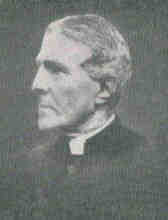 Rev Thomas John Oldrini, M.A.
was the much respected vicar of Beeston, Notts from 23 June 1854 until his death on 18 June 1885 at the early age of 59 years. Rev Thomas John Oldrini, M.A.
was the much respected vicar of Beeston, Notts from 23 June 1854 until his death on 18 June 1885 at the early age of 59 years.
He was born in Westminster, London in 1825, the son of Gerard John and Elizabeth Oldrini. His mother, born Elizabeth Stofer, claimed descendancy from
important lines of the Douglas and Robertson families in Scotland and his father had Italian - notably Milanese - forebears. His father was to have
considerable success as an officer of the House of Lords, under the patronage of Sir Thomas Tyrwhitt, who served as the Gentleman Usher of the Black Rod
between 1812 and 1832, having previously served as confidential private secretary to the then Prince Regent, who became George IV. Tyrwhitt trusted
Oldrini, they became friends and the latter was to be appointed to various positions of standing within the House of Lords, eventually becoming Receiver of Fees
to the House. Gerard Oldrini's eldest brother, Louis Frederic Oldrini, was a law clerk and accountant - and left a substantial estate of almost £8,000
when he died in 1869.
Gerard and Elizabeth and their children - including Thomas John, the elder of two who survived infancy - lived at various times on the Kings Road, in
Pimlico and later, in considerable comfort and style, in apartments associated with the Palace of Westminster. During the whole of this time, which
covered the childhood of Thomas John, the family continued to receive the support of Sir Thomas Tyrwhitt who, in turn, greatly valued Gerard's support
and integrity. This led to a great bond between Sir Thomas and the young Thomas John, such that the boy became greatly indulged by him and was to witness -
even almost becoming part of, many of the great events of those years.
The reason we now know so much about his remarkable early life in particular is that he recorded it in considerable detail in an autobiography which he wrote
for the benefit of his children in whatever spare time he was able to find while he served as a busy Parish priest in Beeston, between 1870 and 1876. A copy of the book has
recently come to light in Australia, within family papers handed down within the descendants of Thomas' youngest child, Gerard Douglas Louis Oldrini who
emigrated in 1909. The story extends to over 400 pages and is being painstakingly transcribed by a 3rd-gt-grandson of Thomas John, William Cooper. Although,
so far, we have only seen the part that describes his ancestry and his early life, already we can see what an interesting and eventful life he had at that
time. In the preamble to his autobiography he modestly describes his life as 'not very eventful' and his experiences as 'mere commonplace'. The reality was that, even
in its first twelve years, he witnessed the spectacle and ceremony of Royalty and Parliament and many great events in London - he saw George IV at the Opening of
Parliament, was outside the Abbey at the coronation of William IV, witnessed the opening of the New London Bridge and was even present at the coronation of
Queen Victoria. Clearly, his claims of an uneventful life were an understatement! The transcript of this fascinating account of a truly interesting life may
be accessed from the menu on the left.
This relatively secure and well connected background was to help John to receive his education at Oxford University, where he graduated with a Master of Arts
degree. In December 1849, apparently when still an Undergraduate, he married Maria Elizabeth Drage at St James, Paddington. Maria was the fifth child
of thirteen born to John Drage, a grocer, chandler, draper and wine merchant with interests in both London and Norfolk,
and Elizabeth Drage his wife. Curiously, and for whatever reason - perhaps the first marriage had been in secret - the couple
married again in March 1851, this time with Maria's family to witness, in the Parish church at East Rudham in Norfolk.
He was that year that Thomas was ordained Deacon and took up an appointment in the Parish of Breaston in Derbyshire, just over the County
boundary from Beeston in Nottinghamshire. It was there, in December of that year, that their first children - apparently twins - were
baptised. In the following year, 1852, he was ordained Priest.
 When he came to Beeston in 1854 to
succeed the Rev John Wooley, he took over a church which had been almost totally rebuilt just over 10 years earlier. The
previous incumbent and his family had chosen not to live in the Vicarage House, preferring the old Hall on Middle
Street (latterly Beech Tree Lodge, then The Cow at Beeston Public House and now demolished; its site is now occupied by the Tesco petrol station). At
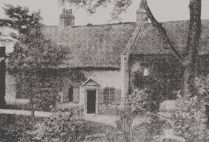
the time Oldrini arrived, he described the old Vicarage (shown here before its demolition) as "a sadly poor place, wretched in the extreme
and partially destroyed by fire" - although its covering of japonica, jasmine and woodbine as well as a splendid horse chestnut tree tended to hide its
shortcomings. A new vicarage, costing £1200 was built in 1860 with the Oldrini family moving-in in July of that year. When he came to Beeston in 1854 to
succeed the Rev John Wooley, he took over a church which had been almost totally rebuilt just over 10 years earlier. The
previous incumbent and his family had chosen not to live in the Vicarage House, preferring the old Hall on Middle
Street (latterly Beech Tree Lodge, then The Cow at Beeston Public House and now demolished; its site is now occupied by the Tesco petrol station). At
the time Oldrini arrived, he described the old Vicarage (shown here before its demolition) as "a sadly poor place, wretched in the extreme
and partially destroyed by fire" - although its covering of japonica, jasmine and woodbine as well as a splendid horse chestnut tree tended to hide its
shortcomings. A new vicarage, costing £1200 was built in 1860 with the Oldrini family moving-in in July of that year.
Click to see photographs of Rev Thomas J Oldrini & his wife Maria
Another concern, at the time of his arrival, was that the church bells were in a poor state. They were only three in number, with one
dating from 1640 and another even earlier. Oldrini observed that they were "far from silvery in tone in later
times, whatever they might have been originally." On Christmas Eve, 1860, one of the bells cracked in the severe
frost. These bells were eventually recast in 1870 by Taylor's of Loughborough
and three more were added; there were dedicated on Shrove Tuesday, 1 March 1870. The absence of the bells had caused
distress in the Parish and, for this happy occasion, the streets were decorated, shops and silk mill were closed
and Oldrini recorded in his diary that there was a 'monster tea party' in the afternoon. Two treble bells, to
complete the peal of eight, were added in 1877, subscribed for by the inhabitants of Beeston and area, to the
memory of John Watson, the late silk mill owner.
Other material achievements during his incumbency included extensions to the National School on Brown Lane (now
Station Road) and the repositioning the organ and choir from the gallery at the west end of the church (which was
then removed) to a new organ chamber and choir stalls in the chancel.
Oldrini proved himself an energetic priest with a kind and affable manner who made it his business to visit every
house in the Parish at least once in every year and the sick regardless of denomination. Amongst his many other
contributions to the well-being of the Parish, he found time to write 'Gleanings - or Something about Beeston in
Olden Times' which was an interesting and useful booklet about Beeston's history. It was published in 1873.
Tantalisingly, he is said to have written a further instalment called 'The History of Beeston - Old and New' which
had not been published at the time of his death. The manuscript has never been found despite efforts by Beeston
historians.
He was buried in Beeston churchyard where his memorial, and that of his wife and parents, may be found. It is said
that his funeral was attended by 3000 persons which shows the esteem in which he was held by all denominations. The
alabaster pulpit that stands in the church to this day, was subscribed for in his memory by parishioners and friends.
Click to read about the The Next Generation of the Oldrini Family
or -
Click here to go back to the beginning
All information relates to the specific individual and/or family shown
and and does not necessarily relate to other individuals or families with the
same surname.
Whilst every effort is made to ensure that information is as
accurate as possible, as in all genealogical research, users should satisfy
themselves as to its accuracy.
We do not knowingly include information relating
to living individuals. |
|
|